
Margin Math for Toy Brands: 2025 Practical Guide on How to Calculate Real Profits from FOB to Retail - Awen Hollek
Updated: Nov 5, 2025
Introduction: The Real Cost of Toy Profitability
Let’s be blunt: the toy business can eat your margin alive if you don’t know your numbers. Many creators think quoting an FOB from a factory and slapping on a markup is enough to price their toy.
Reality check: it’s not.
Margins vanish when you forget tooling, compliance, carton limitations, packaging rules from big-box retailers like Target or Walmart, and the hidden costs of small MOQs. This article walks you through how to price your toy before you develop it—using real-world numbers and strategies toy brands actually use in 2025.
If you’re serious about not losing money per unit—this is your guide.
Disclaimer: This is a simplified but practical guide to toy margin calculation in 2025. We do not include topics such as tariffs and other complexities. Those will be covered in another guide.
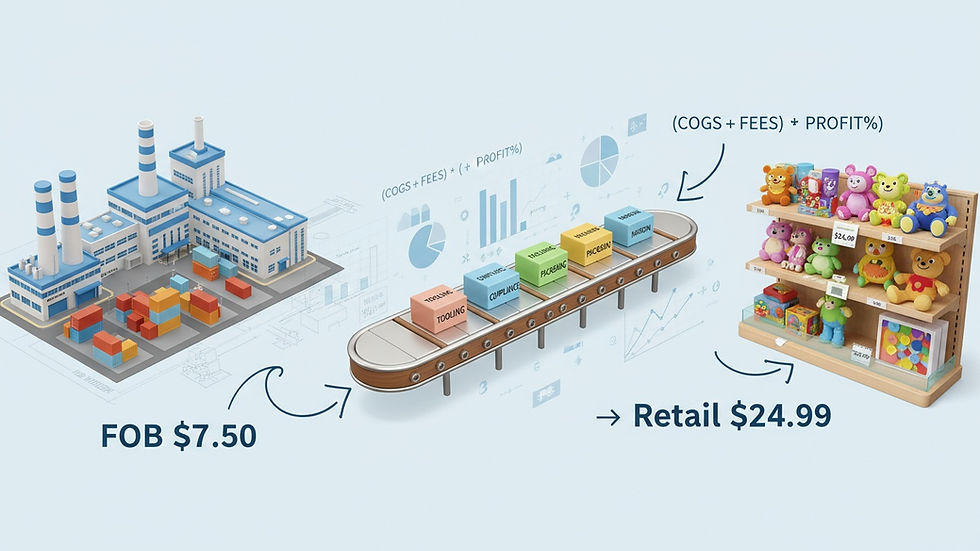
FOB Isn’t Everything: Understanding What’s Included (And What’s Not)
FOB (Free on Board) from a Chinese factory usually includes (Check our article on Incoterms):
The product itself
Labor and assembly
Packaging (blister, box, instructions, etc.)
Carton packing
Transport to port (e.g., Shenzhen, Ningbo)
But here’s what FOB does not include unless agreed upfront:
Tooling amortization
Compliance testing (EN71, ASTM F963, etc.)
Your own margin
Defect buffers (for breakage, returns, claims)
Freight, insurance, tariffs (in case you import goods on your own)
So, while FOB is your starting price, it’s far from your real cost per unit.
Toy Margin Calculation 2025 Case Study: When You Start with 3,000 Units
Let’s take a real toy example (or at least well-imagined in the toy world) developed with a factory:
FOB (3,000 units): $7.50
Tooling: $20,000
Global compliance (EU + US): $5,000
Retail Price: $24.99
Retailer Purchase Price: $12.50
🧮 Unit Cost Breakdown:
Component | Value |
FOB per unit | $7.50 |
Tooling amortized | $20,000 / 3,000 = $6.67 |
Compliance testing | $5,000 / 3,000 = $1.67 |
Total base cost | $15.84 per unit |
Wait, what? You’re selling to the retailer for $12.50? You’re losing $3.34 per unit unless you adjust your assumptions or scale.
That’s the kind of miscalculation most new toy brands make—because they skip this math.
Tooling and Compliance: Why Small Runs Get Expensive
Tooling
Custom plastic parts, molds, or injection tools can range from $10,000 to $80,000+. Most factories won’t include tooling in FOB—it’s billed separately.
👉 If you only produce 3,000 units, that tooling cost must be absorbed in your margin.
Compliance
Global standards like EN71 (EU) or ASTM F963 (US) are mandatory. Full test suites cost $2,000–$10,000 per product, depending on complexity.
Testing is not reusable between regions—so double the cost if you sell in both the EU and US.
📉 These costs are crippling in small batches—you recover them only at volume.
Retailer Expectations: Master Carton Size, MOQ, and Order Scaling
Retailers like Target or Walmart have strict requirements:
Max master carton depth: 15 inches (so it fits shelf depth)
Minimum/maximum unit per carton rules
Case pack consistency and shelf-ready packaging
Carton labeling and compliance barcodes
MOQ flexibility: many start with 3,000–6,000 units, then scale up later
❗ Why this matters:
If your toy is bulky and doesn’t maximize carton space, freight and packaging costs per unit skyrocket. More air = more dollars wasted.
📦 Example:
If you only fit 8 units per master carton instead of 16, your per-unit carton cost doubles.
And if you don’t plan this at the design stage—you can’t fix it later.
Rule of Thumb Explained (And Where It Falls Apart)
In the toy industry, many use this “rule of thumb”:
📐 Retail price ≈ (FOB + your margin) × 4
But this assumes you’re selling directly to retailers, not importing and selling yourself.
🔄 Here’s how it actually works:
Factory gives you FOB = $7.50
You add your margin (say 20%) → $9.00
Retailer doubles your price → $18.00 shelf price
Retailer sets actual shelf price = $24.99
You’re expected to absorb tooling, compliance, freight, etc., in that $1.50–$2.00 margin
🎯 Key Insight:
The “×4” rule only works if:
You negotiate well
You already baked tooling, compliance, and buffer into FOB
You sell large volumes
Otherwise, it breaks instantly.
Margin vs Markup: What You Really Need to Know
Let’s clear up the most common confusion:
Term | Formula | Based On |
Margin | (Price – Cost) ÷ Price | Based on Price |
Markup | (Price – Cost) ÷ Cost | Based on Cost |
🔢 Example:
FOB: $7.50
Your selling price to retailer: $12.50
Margin: (12.50 – 7.50) ÷ 12.50 = 40%
Markup: (12.50 – 7.50) ÷ 7.50 = 66.7%
📌 Margin tells you how much you keep.
📌 Markup tells you how much you added.
Don’t confuse them—they’re not interchangeable.
How to Build Your Pricing From the Ground Up
Here’s the smarter way to price:
Start from your FOB quote
Add:
Tooling amortization (based on expected volume)
Compliance testing
QC failure buffer (3–5%)
Internal margin (~15–25%)
That’s your selling price to the retailer
Multiply ×2 for estimated shelf price
Then, ask the retailer if this shelf price makes sense for their market. If not—go back and rework cost, packaging, size, materials.
Reverse Engineering: Start From Retail, Work Backwards
Sometimes, a retailer says: “We want it at $24.99 retail.”
Then you need to reverse-engineer:
Shelf price: $24.99
Retailer margin: 50%
You sell at $12.50
You want 20% margin → $10.00 COGS
Tooling + compliance = $2.00 per unit
Your target FOB = $8.00 max
If your factory can’t meet $8.00 with all-in cost—you need to:
Redesign
Change materials
Scale production
Negotiate harder
Visual Margin Breakdown Using Real Numbers
Item | Value |
Factory FOB | $7.50 |
Tooling amortized | $6.67 |
Compliance amortized | $1.67 |
Total Unit Cost | $15.84 |
Selling Price to Retailer | $12.50 |
Profit per Unit | –$3.34 😬 |
Conclusion: You’re losing money.
Solution: Scale production, cut tooling costs, spread compliance costs over multiple SKUs, or redesign for cost-efficiency.
Tips to Protect Your Margin Despite Real Constraints
Design packaging early to optimise carton density
Align product size with master carton rules (e.g. 15” depth for retailers)
Batch testing: test multiple SKUs together to reduce cost
Plan tooling amortisation realistically—not over 3,000 units
Push for longer-term orders (e.g., 6K + 6K + 12K reorders)
How Awen Hollek Helps You Build a Profitable Toy
At Awen Hollek, we go beyond sourcing. We help you:
Model your cost before development
Negotiate realistic FOBs that include the hidden costs
Design toys that fit retailer shelf rules and carton constraints
Forecast pricing from retail backwards, not factory forwards
Guide you on scaling, compliance, and amortisation strategies
💬 Need help pricing your next toy before spending a cent?
💬 Frequently Asked Questions
1. What is included in the FOB cost for toys?
Answer: FOB (Free on Board) usually covers the product, packaging, labor, assembly, and delivery to the port in China. However, it typically excludes tooling costs, compliance testing, freight, tariffs, and your own margin. Always double-check what’s actually included with your supplier.
2. What’s the difference between markup and margin?
Answer:
Margin = (Selling Price – Cost) ÷ Selling Price
Markup = (Selling Price – Cost) ÷ Cost
They’re not the same. Margin tells you how much you keep per sale as a percentage of the price. Markup tells you how much you added on top of cost.
3. How does master carton size impact toy pricing?
Answer: Retailers like Walmart and Target often impose strict master carton depth limits (e.g., 15 inches) to fit their shelf systems. If your toy’s packaging doesn’t optimize the carton space, you’ll fit fewer units per carton—drastically increasing the per-unit shipping and packaging cost.
4. What is the FOB × 4 rule of thumb in toy pricing?
Answer: It’s a simplified method where the retail price ≈ (FOB + your margin) × 4. This only works if you’re selling directly to retailers, and your FOB already includes tooling amortization, compliance, and buffer. If you import and resell yourself, the math changes significantly.
5. Why is it critical to plan toy pricing before development?
Answer: If you don’t know the retail price range from the start, you can easily develop a toy that’s too expensive to ever sell. Retailers have strict price expectations, so reverse-engineering your costs from the expected shelf price is crucial for success and profitability.


Comments