
How to Reduce Compliance Risk Before Developing a Toy in China

A lot of toy projects do not fail because the lab was harsh.
They fail because the product was developed as if compliance could be dealt with later.
That usually means material choices were made too casually, age grading stayed vague for too long, packaging assumptions came in late, electrical risks were underestimated, or the team treated testing like a finish-line formality instead of what it really is: a late-stage confirmation of earlier decisions.
By the time a toy fails testing, the damage is often already done. Tooling may be underway. Samples may already be approved. Packaging may be moving. Deadlines may be tightening. And every correction suddenly costs more than it should have.
If you want to reduce compliance risk in China, the real work starts long before the lab report.
Why toy compliance problems usually start before testing
Testing does not create compliance.
It verifies it.
That sounds obvious, yet plenty of teams still behave as if the lab is where toy safety begins. It is not. By the time a toy reaches formal testing, the key assumptions behind the product have usually already been made: materials, construction, accessible parts, battery layout, cord lengths, labeling approach, age grading, packaging format, and the level of technical discipline applied during development.
So when a toy fails, the lab is often not the root problem. It is simply the first place where the project is forced to admit what development ignored earlier.
A failed lab report is often just the first moment the product stops pretending everything is fine.
That is why late compliance thinking gets expensive. It creates rework. It delays launch. It forces changes at exactly the stage where changes are slowest and most painful. And if tooling is already committed, the project loses flexibility when it needs it most.
Good compliance planning is not about being cautious for the sake of it. It is about protecting the project while the product is still flexible enough to be corrected properly.
Start with the target market, not the toy idea alone
A toy cannot be developed properly for “somewhere.”
It needs a destination.
If the team is still saying things like “we’ll probably sell in Europe first, but maybe the US too” or “let’s see where demand comes from,” that is not a strategy. It is a soft spot. The target market changes what needs to be planned, what needs to be documented, what warnings may apply, how labels are handled, what testing path makes sense, and which design choices should be challenged earlier.
A toy built for “somewhere in the world” is usually a toy being developed without enough discipline.
The earlier you lock the intended market, the easier it becomes to plan intelligently. That does not mean every detail must be frozen at concept stage, but the overall compliance direction should not stay vague. If the toy is meant for the EU, that affects development assumptions. If it is meant for the US, that affects the documentation path and product review process. If it is electrical, that changes even more.
Teams sometimes resist this because they want to stay flexible. Fair enough. But fake flexibility is expensive. It feels convenient at the beginning and chaotic later.
If you already know where the product is supposed to go, act like it.
Age grading changes more than most teams expect
Age grading is one of those decisions that people love to leave until later.
That is a mistake.
It is not just a label on the box. It affects the whole product logic. Small parts, detachable accessories, soft filling access, seam performance, cord lengths, battery access, decorative elements, mechanical resistance, packaging warnings, and user expectations can all shift depending on the intended age grade.
A team may start with a toy that is “probably for three-plus,” then later decide it would be commercially stronger at a younger age. That kind of late change can create serious trouble. The product may already be built around assumptions that no longer fit. Decorative pieces that seemed harmless become a risk. A compartment that looked acceptable may suddenly need redesign. Materials or construction details may no longer sit comfortably with the revised category.
Age grading should sit much closer to the beginning of development than many teams assume.
Not because it solves everything on its own, but because it changes what the rest of the product is allowed to get away with.
Material choices can quietly create compliance problems early
Material risk is one of the most common ways a project creates trouble for itself without realizing it, because material changes often happen during supplier-side cost pressure and sourcing discussions.
A prototype may look fine. A sample may feel fine. A supplier may say they used “the same material as before.” None of that guarantees the compliance profile is actually under control.
Plastics, coatings, inks, foams, adhesives, textiles, stuffing, surface finishes, elastics, and decorative treatments all deserve more respect than they usually get. So do substitutions. That is where things often go sideways. The buyer signs off on one version, the supplier quietly pushes a slightly different option for cost or speed, and suddenly the compliance assumptions the project was leaning on start looking less stable.
A cheap material change can turn a “nearly ready” toy into a compliance problem with packaging already printed.
This is one of the reasons compliance risk is not just a test-lab topic. It is a development-discipline topic. Material decisions should be treated as part of product control, not casual sourcing housekeeping. If the material changes, the review should change with it. Not because every substitution is disastrous, but because some of them matter a lot more than they look.
And in toys, “looks the same” can be dangerously misleading.
Electrical and battery-related toys need earlier discipline, not later panic
The moment a toy includes batteries, lights, motors, sound, charging functions, or any other electrical feature, the project needs to get more serious.
Not later. Earlier.
Electrical and battery-related products are often where teams discover just how expensive vague thinking can become. A toy may look exciting as a concept, but the practical questions come fast: how is the battery compartment secured, how accessible are components, what happens under foreseeable misuse, how is heat managed, what happens when children drop it, bend it, overuse it, or use it exactly the wrong way?
The later electrical safety enters the conversation, the more expensive the conversation usually becomes.
Some teams try to deal with all of this after the prototype stage, as though the electrical side can be “cleaned up later.” But once layout assumptions and mechanical constraints are already set, fixing these issues tends to become a much uglier exercise. Suddenly the shape is wrong, the compartment is too weak, the connector choice is awkward, the warning logic is incomplete, or the user-behavior assumptions were naïve from the start.
Electrical toys are perfectly achievable. They just punish sloppy sequencing faster than simpler products do.

Mechanical safety starts in design, not in the lab
Not every safety issue looks dramatic in the early stages.
That is part of the problem.
Weak joints, brittle decorative elements, poorly retained wheels, breakable snap-fits, thin walls, loose eyes, cords that looked harmless, pinch points no one thought through properly, accessible stuffing after wear, edges that become an issue only after breakage — these are not always lab-created problems. They are usually design or construction choices that waited too long to be challenged.
The lab is where those choices become official. It is not where they started.
That is why development reviews need to be more than appearance reviews. Too many sample approvals are basically visual. Does it look right? Does it function? Does it feel good? Is the cost acceptable? Those are important questions, but they are not enough. Safety is shaped long before the report lands. If the project is not reviewing mechanical behavior early, it is simply outsourcing that thinking to the most expensive stage.
That is rarely a clever strategy.
Packaging and labeling should not be treated as a last-minute admin job
Packaging gets pushed to the end all the time.
Then people act surprised when it becomes a problem.
Warnings, age marks, battery instructions, traceability information, manufacturer or importer details, material statements, product naming consistency, and packaging format all affect how smoothly the project closes out. If the packaging is being developed in a separate lane, with little connection to the product team, there is a decent chance the right hand is building something the left hand will later have to fix.
If the product and the packaging are being developed on parallel tracks with no compliance coordination, somebody is setting up a future problem.
This does not mean packaging needs to be finalized absurdly early. It does mean the product and packaging should be reviewed as part of the same compliance conversation. The more a team treats packaging like a cosmetic wrapper added at the end, the more likely it is to miss something obvious until the timeline is already tight.
And that is exactly when “just one small wording change” stops being small.
Why prototype approval is a dangerous moment if compliance is still vague
Prototype approval feels good.
That is precisely why it can be risky.
When a sample finally starts looking like a real product, teams are tempted to move forward on momentum. The toy looks right. The function works. The internal team is excited. The supplier is asking whether tooling can start. Everyone wants to believe the hard part is behind them.
Sometimes it is.
Sometimes it absolutely is not.
“Looks good” is not the same as “safe, label-ready, and test-ready.”
If compliance assumptions are still fuzzy at prototype stage, approval can lock in bad decisions very quickly. A product that should still be under review suddenly gets treated as if it were mature. A weak assumption survives because nobody wants to slow the project down. A design freeze happens before the real risks were closed. And once tooling starts, the conversation changes. Fixing things becomes slower, more political, and more expensive.
Prototype approval is not just a visual milestone. It is a control point. Treat it like one.

How to build compliance into the toy development process
This is where teams usually need a more disciplined structure.
Not a giant bureaucratic system. Just a clear one.
At concept stage
Define the target market. Decide the likely age grade. Flag whether the toy is electrical, mechanically sensitive, chemically sensitive, or dependent on any material choices that deserve extra care. At this stage, the point is not to solve every detail. It is to stop pretending the product can develop in a vacuum.
At design stage
Review materials, construction assumptions, and likely warning implications. Look at what the toy is asking from the user, and what it might allow under foreseeable misuse. If it includes batteries, mechanisms, detachable accessories, soft filling, decorative parts, cords, or structural stress points, those should be discussed early. Not admired later.
At prototype stage
Check whether the real sample still matches the compliance assumptions made earlier. Prototypes often reveal things drawings politely hide. Maybe a part is easier to detach than expected. Maybe a material finish is more fragile. Maybe battery access is clumsier than planned. This is where technical comments and compliance thinking should be working together, not sitting in separate departments pretending not to know each other.
Before tooling
This is where many projects get reckless. Before tooling is released, the team should know what is frozen, what is still unresolved, what materials are actually approved, how packaging and labeling are expected to land, and what test path the project is moving toward. Tooling is not a therapy session. It is not where the project goes to discover itself.
Before production
By this stage, the approved sample, final artwork, warnings, and supplier understanding of critical compliance points should all be aligned. If they are not, the risk is no longer abstract. It is moving toward cartons.
That is what a more mature process looks like. Not glamorous. Very useful.
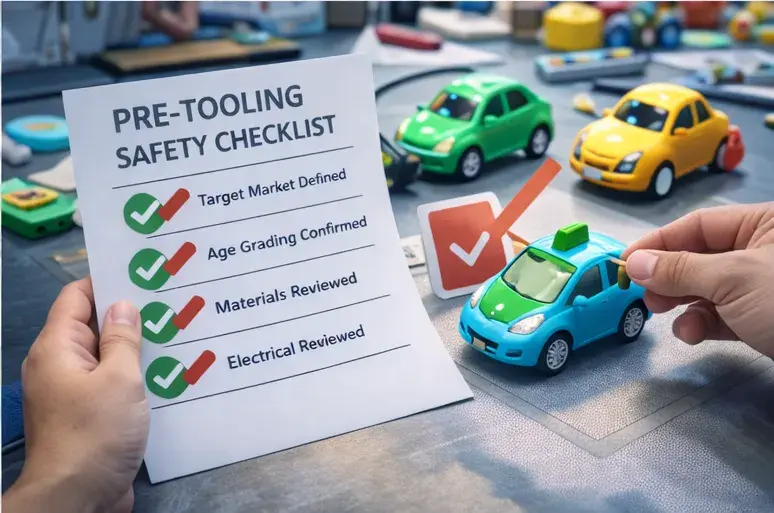
Common early mistakes that create expensive compliance trouble later
Some mistakes show up again and again.
The target market stays vague for too long.
The age grade gets chosen late.
Materials get swapped for cost without proper review.
Electrical questions are pushed into the prototype stage.
Packaging and warnings are left to the end.
Prototypes are approved on looks and basic function, not actual risk.
The supplier is selected without enough confidence in their compliance awareness.
Tooling starts before unresolved issues are properly closed.
Testing is treated as the stage that will somehow “catch everything.”
It won’t.
That is not what it is for.
Reducing compliance risk is not about slowing the project down
This is the part some teams struggle with.
They hear “early compliance planning” and imagine process drag. Too many reviews. Too much paperwork. Too many people waving caution flags while the commercial timeline burns.
But that is not what good compliance planning is supposed to do.
Good compliance planning does not kill momentum. It stops fake momentum from turning into expensive rework.
There is a difference.
A project moving quickly in the wrong direction is not efficient. It is just temporarily optimistic. Structured review early is usually cheaper than correction late. The point is not to smother the product with process. The point is to stop the team from tripping over predictable problems after the expensive decisions are already locked.
That is not bureaucracy for its own sake.
It is project protection.
Final takeaway
If you want to reduce compliance risk in China, do not wait for the lab report to start caring.
By then, the most important decisions may already have been made.
The safest toy projects are usually not the ones with the best rescue effort at the end. They are the ones where compliance was treated as part of development from the start: in age grading, materials, construction, electronics, packaging, supplier alignment, and tooling decisions.
That is how risk gets reduced.
Not by panic-testing at the finish line.
Need help planning toy compliance before development goes too far?
If your project is still at concept, prototype, or pre-tooling stage and you want to reduce compliance risk before mistakes become expensive, Awen Hollek supports overseas brands, inventors, and distributors with toy product development, compliance planning, supplier coordination, and China-side project follow-up.
FAQ: Reducing Toy Compliance Risk Before Development in China
When should toy compliance planning start?
Toy compliance planning should start at concept stage, not after prototyping or before shipment. Early decisions about target market, age grading, materials, construction, and packaging often shape whether the product can pass later testing efficiently.
Why do toys fail compliance testing late in development?
Many toys fail late because the real problems started earlier. Weak material choices, vague age grading, unresolved mechanical risks, electrical-layout issues, and late packaging decisions often show up only once formal testing forces the project to confront them.
Does lab testing make a toy compliant?
No. Lab testing verifies whether the toy, as developed, meets the required standards. It does not fix poor decisions made during concept, design, material selection, or pre-tooling stages.
Why is age grading important so early in toy development?
Age grading affects small-parts risk, seam strength, battery access, cords, detachable elements, packaging warnings, and overall product expectations. Leaving it too late can force costly redesigns.
What is one of the biggest compliance mistakes toy buyers make in China?
Treating compliance like a final checkpoint instead of part of development. By the time a failed test report appears, many expensive decisions may already be locked in.


Comments