
When a Toy Factory Offers "Same Material": What Buyers Should Ask Before Accepting Substitutions
When a toy factory says the substitute is the "same material," the phrase usually sounds calmer than it should.
It sounds as if the factory is asking for a minor administrative adjustment. Same material. Same look. Same function. Same price logic, maybe even a little better. Nothing serious. Just approve it so production can keep moving.
That is exactly how buyers get pushed into weak change control.
In toy production, "same material" is not a technical conclusion. It is often a commercial sentence. It can hide a different resin grade, a different pigment package, a different recycled-content ratio, a different coating, a different surface finish, a different supplier, a different declaration trail, or a different assumption about what the approved sample actually represented. The wording sounds narrow while the risk can spread across compliance, performance, appearance, and shipment documentation very quickly.
This is why toy material substitution should be treated as a controlled buyer decision, not a casual factory convenience. If the approved sample, bill of materials, supplier declarations, packaging claims, and later shipment documents are supposed to describe one controlled product, the buyer cannot accept a substitution on tone alone.
That matters commercially. Once a substitute enters mass production, the argument changes. Before approval, the buyer can still ask hard questions. After approval, the factory tends to treat the new route as normal. If the substitute later creates a performance problem, a colour mismatch, a failed material declaration, a document inconsistency, or a market-surveillance headache, the buyer is no longer debating a proposal. The buyer is trying to unwind reality.
That is where Toy Batch Records and Production Traceability: What Buyers Should Ask Factories to Keep and CPSIA Toy Compliance Paperwork for Toy Importers: What Has to Match Before You Ship both matter. Material substitution is not only about the part itself. It affects whether the production story still matches the paperwork story later.
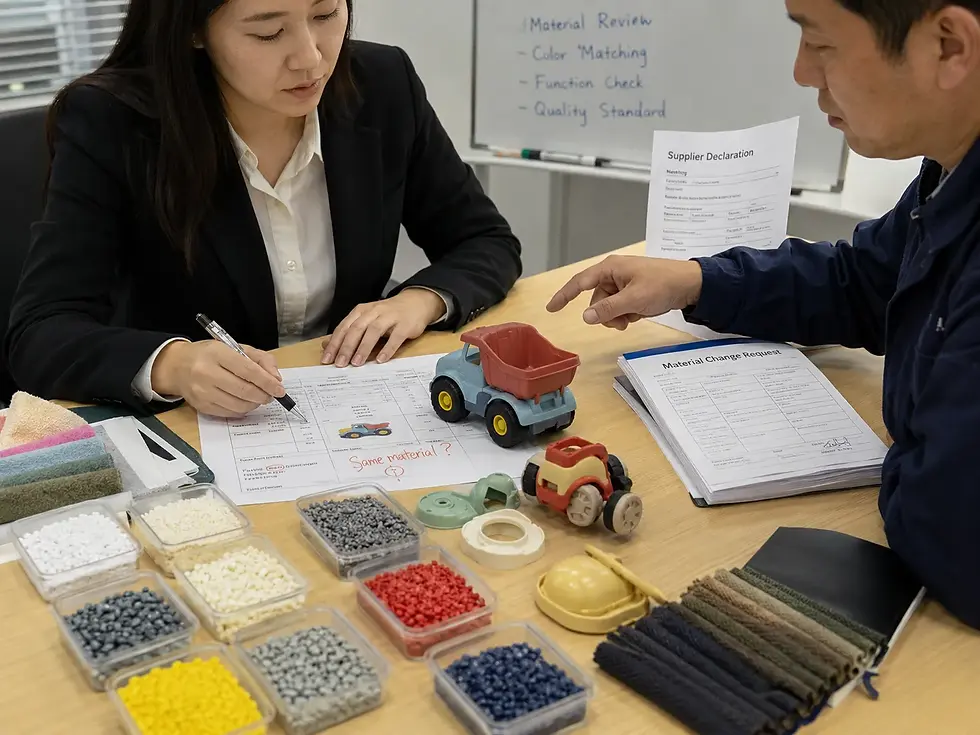
Why "same material" is not the same as "same specification"
The first thing buyers need to challenge is the language itself. Material names are often used too loosely inside factories and buying teams. Somebody says ABS, TPR, PP, polyester, water-based paint, PU coating, or soft PVC as if the category label finishes the discussion. It does not.
Within the same family name, a lot can still move. A resin grade can change. The melt flow can change. The hardness can change. The filler content can change. The pigment recipe can change. The supplier can change. The surface treatment can change. Recycled content can change. If the toy uses printed parts, coated parts, flexible parts, plush materials, fillings, or accessories, the meaningful compliance and quality differences often sit inside those hidden details rather than in the broad material label on the factory spreadsheet.
That is one reason the CPSC toy safety business guidance and European Commission toy safety framework are useful even when they do not tell you how to run a factory change request. Both frameworks remind buyers that toy safety lives inside a controlled product route. The toy entering the market is supposed to match the version that was designed, assessed, documented, and shipped. A vague phrase from the supplier does not prove that continuity.
The buyer should therefore treat "same material" as a claim that needs evidence, not as evidence by itself.
That is especially true when the factory adds one of the usual pressure lines: same material but cheaper, same material but original supplier out of stock, same material but local source, same material but delivery faster, same material but colour slightly more stable. None of those statements answer the real question. They explain why the supplier wants the change. They do not prove that the new route is equivalent.
And equivalence is the real issue. Buyers do not need the factory to promise comfort. Buyers need the factory to show what exactly changed, what exactly did not change, what documents are affected, and what test or re-sampling logic now becomes necessary.
The hidden differences buyers should force the factory to spell out
A weak material-substitution request usually stays at the level of category names. A strong one goes down to the practical details that affect toy quality and compliance.
Start with supplier identity. If the material supposedly stays the same but the source mill, compounder, coating supplier, fabric supplier, or ink supplier changes, the buyer should treat that as a real change. Same family name does not mean same production route. Supplier substitution can change traceability, declaration quality, consistency, and the factory's ability to reproduce the approved sample later.
Then move to formulation details. A plastic can look similar while the additive package, flexibility, colourant load, flame-retardant route, or recycled-content proportion changes. A painted part can look visually acceptable while the coating system underneath is different. A plush fabric can feel close enough in hand while the finish, backing, pile quality, or dye route changes. A print can look the same in a photo while the ink route and abrasion behaviour are different. Buyers should stop letting visual similarity do the job of specification control.
Documentation is the next trap. Once the toy is intended for the U.S., EU, or UK market, the declarations and supporting compliance path matter. The CPSC guidance on Children's Product Certificates matters here because the certificate logic is supposed to describe the children's product actually being shipped, supported by the right testing and records. If a material route changes, the buyer has to ask whether the declaration set, test assumptions, and product identity are still describing the same thing. If not, the paperwork has quietly become weaker than the production reality.
Tracking and batch identity matter too. The CPSC tracking-label guidance is usually discussed later in the process, but the logic belongs here as well. If material substitutions are accepted casually and not tied back to approval dates, batches, and revised documents, the buyer loses the ability to explain which goods used which route later. That is not a clerical problem. It becomes a real business problem the moment a complaint, failed check, or retailer question appears.
The short version is simple. Same look is not same formulation. Same category name is not same supplier route. Same feel is not same declaration trail. And same sales pitch is definitely not same risk.
Which toy parts are most likely to drift when a factory offers a substitute
Not every toy part attracts the same substitution risk. Buyers should pay extra attention to any part that carries appearance pressure, cost pressure, flexibility, coating, print, or direct child contact.
Flexible plastic parts drift easily because factories are often tempted to treat "soft part" as a broad bucket. Grips, soft wheels, squeeze features, bath-toy parts, bendable accessories, tubing, coated wires, and flexible connectors deserve direct scrutiny. If the accessible plasticized route changes, the buyer should revisit whether the declaration and compliance assumptions still hold. The CPSC phthalates business guidance is a clear reminder that flexible components cannot be controlled with vague language.
Painted and coated parts are another common failure point. Buyers often focus on the substrate and forget the decorative layer. The part looks right, so everybody moves on. But a coating swap can change adhesion, rub resistance, odour, colour stability, and the compliance route behind the finish. The visual pass on the inspection table does not prove the route remained equivalent.
Printed packaging-adjacent parts and labels also drift more than teams admit. A factory can swap label stock, print supplier, coating, or adhesive and still say the material is basically the same. That sounds harmless until the shipment uses a different sticker behaviour, poorer adhesion, or a declaration trail that no longer matches the earlier sample set. Buyers who already learned that lesson in Toy Pre-Shipment Inspection in China: What to Check Before the Goods Leave should not wait until final inspection to revisit it.
Soft components deserve the same caution. Plush shells, woven accessories, decorative patches, fillings, trims, and sewn-in labels are often described loosely because they look less technical than molded parts. That is a mistake. Soft materials are still a specification route. The factory should not be allowed to slide from one fabric source or finishing route to another under the umbrella of "same material" unless the buyer is shown exactly what changed.
Finally, do not ignore hidden components just because they are not prominent in the beauty shot. Inserts, support pieces, inner structures, backing materials, pads, foams, and accessory carriers are exactly where factories try to save cost quietly. The toy can still photograph well while the internal route drifts away from the approved sample logic.

What evidence to ask for before approving a material substitution
The correct buyer move is not to reject every substitute automatically. It is to make the factory prove the change in a structured way before approval.
First, ask for a written change request that identifies the exact original route and the exact proposed route. Not broad names. Exact material description, supplier name, part reference, affected SKU or SKU range, reason for change, and requested effective date. If the factory cannot frame the request clearly on paper, it is not ready for approval.
Second, ask what else is affected. That means appearance, mechanical performance, fit, smell, touch, print behaviour, coating durability, packaging interaction, declaration path, and any test scope that might need to be revisited. The right question is not "is it safe?" The right question is "what assumptions in the current approved pack stop being safe to rely on if I approve this?"
Third, ask for the evidence pack. That usually means updated specification sheet, supplier declaration where relevant, sample photos or retained-sample comparison, BOM revision, and the factory's view of whether re-sampling or re-testing is needed. If the answer comes back as "no problem, trust us," the buyer should treat that as a failure to support the request properly.
Fourth, ask whether the approved sample was built from the same route the factory now says is unchanged. That sounds obvious, but it catches a lot of weak control. Sometimes the sample-room build used one route, the costing team assumed another, and mass production is quietly moving toward a third. By the time the factory says "same material," nobody is talking about the same baseline anymore.
Fifth, ask how the decision will be tied to batches and future records if approved. This is where the buyer protects the next problem, not only the current one. If a substitution is approved, the factory should be able to identify which production date, lot, or PO range used it. If it cannot, the buyer is approving drift without containment.
The buyer is not being difficult by asking these questions. The buyer is doing the exact work that stops a substitution request from turning into an undocumented product change.
When buyers should reject the substitution or insist on re-sampling and re-testing
There are some cases where the right answer is not further discussion. It is no, or at least not without a fresh approval path.
If the substitute changes an accessible flexible material, a coating route, a printed decorative route, a soft component finish, or a supplier whose declaration quality matters, the buyer should be very reluctant to wave it through casually. If the toy's compliance position, performance feel, or appearance consistency depends on that route, re-sampling is often the cleaner commercial choice.
The same applies when the factory cannot produce a coherent evidence pack. If the request is vague, the supplier route is not named, the declaration path is weak, or the factory cannot explain the impact on the approved sample and BOM, the buyer should not solve the supplier's uncertainty by donating approval.
Another red flag is schedule pressure disguised as reassurance. When the factory says approval is urgent because production is waiting, the buyer should ask why the substitute was not escalated earlier. Urgency does not make a weak request stronger. It usually means the factory wants the buyer to absorb the decision risk quickly so production can keep moving.
Re-testing is not needed for every change, but the buyer should insist on it when the changed route affects the assumptions behind the earlier result. The decision should be based on product logic, not on frustration with lead time. If the material route behind the approved product has changed meaningfully, old comfort should not be reused as if nothing happened.
The EU Safety Gate alerts are useful here for one reason: they are a steady reminder that product issues rarely care whether the internal factory message sounded minor at the time. Small-seeming control failures often become visible much later, when fixing them is far more expensive.
How to document the approval so the next batch does not drift again
Once a substitution is approved, many teams relax too early. That is another mistake. Approval is only half the job. The second half is making sure the factory cannot treat the approval as a permanent permission slip for future drift.
The buyer should update the controlled BOM or specification reference, note the exact approved route, keep the approval date and approver visible, and define which SKUs, POs, or production windows the approval applies to. If the approval is conditional, that condition should be written clearly. For example: approved only after updated declaration, approved only for one urgent batch, approved only with new retained sample, approved only after packaging label check, approved only if revised coating test result is attached.
That documentation discipline is what keeps one change request from mutating into permanent ambiguity.
It also protects future inspections. If the inspector later sees a slightly different feel, finish, or accessory route, the team should be able to tell whether it was the approved substitute or a new unapproved drift. Without that record, every future conversation becomes subjective.
The factory should also know what to do if the substitute becomes the ongoing route. That might require new sample retention, new declarations, a revised internal part code, a supplier record update, or a refreshed test plan. Buyers lose a lot of control when they approve a change but leave the factory using old identifiers that describe the previous route.
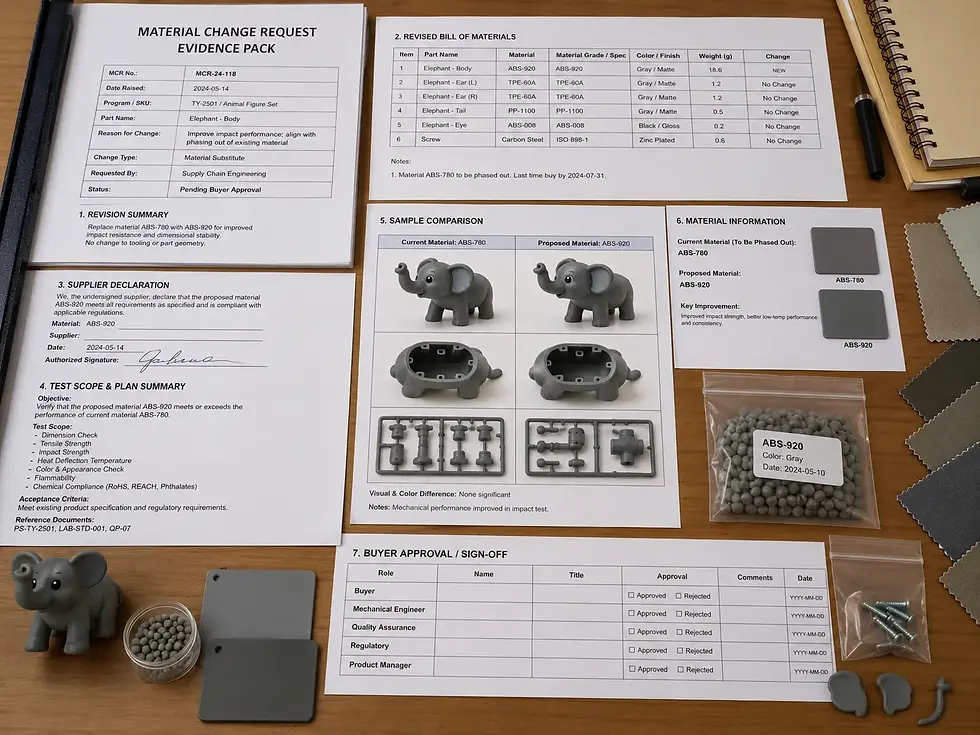
A practical buyer checklist for material substitution approvals
If a factory asks for approval, the buyer should be able to answer these questions before saying yes:
1. What exact part or material route is changing? 2. Is the supplier source changing, or only the nominal material name staying the same? 3. Does the approved sample definitely represent the current baseline? 4. Which declarations, BOM lines, labels, records, or test assumptions are affected? 5. Does the change touch accessible flexible, coated, printed, soft, or otherwise sensitive components? 6. Is re-sampling or re-testing needed to support the decision honestly? 7. How will the approval be tied to batches, POs, and future inspections so the drift stays contained?
That checklist is short on purpose. Buyers do not need a dramatic workflow. They need a repeatable discipline. The commercial win is not that every change becomes slow. The win is that bad changes stop getting approved on vibe alone.
Why disciplined substitution control saves money even when the factory dislikes it
Factories often treat buyer change control as friction. In the short term, it is. It slows down casual approvals. It forces paperwork that some suppliers would rather skip. It can expose that the approved sample logic was looser than everyone pretended.
But commercially, disciplined control is cheaper.
It is cheaper than retesting after the goods are already built. It is cheaper than arguing over whether the shipment still matches the certificate pack. It is cheaper than trying to explain why the approved sample and the export cartons feel slightly different. It is cheaper than discovering too late that the substituted route changed the smell, colour stability, flexibility, print behaviour, or declaration credibility of the product.
Strong buyers understand that the right place to spend discipline is before production hardens around a weak assumption.
That is the real lesson behind toy material substitution. "Same material" is not a buyer decision. It is the beginning of a buyer investigation. The approval should come only after the factory proves equivalence clearly enough that the product, paperwork, and batch record still describe one controlled toy rather than a drifting negotiation.

Need help turning supplier substitution requests into controlled buyer decisions before production drifts into avoidable risk? Awen Hollek helps overseas toy brands, importers, and distributors lock the specification, challenge vague same-material claims, and document change approvals before the factory turns a small shortcut into a bigger shipment problem.
FAQ
What does "same material" really mean when a factory says it?
Usually not enough by itself. It may mean the factory believes the broad material family is similar, but it does not prove the same supplier, grade, formulation, coating, declaration trail, or production behaviour.
What proof should buyers ask for before approving a substitution?
At minimum, a written change request, exact original and proposed material route, supplier identity, updated specification or BOM line, relevant declarations, impact note, and the factory's explanation of whether re-sampling or re-testing is required.
When does a toy material change need re-sampling or re-testing?
When the changed route affects the assumptions behind the approved sample or earlier compliance path. If the substitute changes accessible flexible materials, coatings, prints, soft-component finishes, supplier identity, or other sensitive routes, buyers should be cautious about relying on old comfort.
Should buyers accept a different supplier if the material name is unchanged?
Not automatically. A supplier change is still a real product-control change because it can alter traceability, declaration quality, consistency, and the practical behaviour of the part even when the broad material label sounds familiar.
What documents should be updated after a material substitution is approved?
The controlled BOM or specification reference, the approval record, any relevant declarations, retained-sample references where needed, and the batch or PO mapping that shows which goods used the approved substitute.


Comments