
Pre-Shipment Inspection for Toys: What Buyers Should Check Beyond AQL
A toy pre-shipment inspection is often discussed as if AQL is the decision.
It is not.
AQL is a sampling tool. It helps the buyer decide whether the sampled lot is within an agreed defect tolerance. That matters. But it is only one part of a shipment release decision, and for toys it is often the smaller part of the real commercial risk.
A toy lot can pass a basic AQL count and still be the wrong shipment to release. The carton quantity may be wrong. The barcode may point to the wrong SKU. The warning label may be using an older age grade. The packaging artwork may not match the approved file. The batch identity may be vague. The product may function inconsistently across SKUs. The test and certificate file may describe a slightly different version of the toy than the one now sitting in export cartons.
That is where buyers get hurt. They pay attention to the pass or fail line, but not enough to the release question behind it: should these exact goods, in these exact cartons, with these exact labels and records, actually be allowed to leave the factory?
For overseas toy buyers, Amazon sellers, distributors, and brand teams sourcing from China, that distinction matters. Once the balance is paid and the goods move, leverage collapses fast. Rework gets slower. Arguments get harder. Document mismatches become customs, retailer, or Amazon problems. A toy inspection therefore has to do more than count cosmetic defects. It has to support a release decision that can survive after the goods leave the building.

What AQL actually does, and what it does not do
The practical attraction of AQL is obvious. Buyers cannot usually inspect every unit. A sampled decision gives structure to the inspection. The team agrees a sampling plan, classifies defects, inspects the chosen units, and decides whether the lot falls inside the allowed acceptance number.
That is useful discipline. It prevents purely emotional arguments and gives the factory and buyer a shared inspection method. The ISO 2859-1 sampling framework sits behind the logic many inspection teams use when they talk about acceptance sampling by attributes.
But buyers make a mistake when they let that structure become the whole release decision.
AQL does not prove every unit is good. It does not rescue a weak product specification. It does not tell the buyer whether the labels, packaging, and documents still match the approved product. It does not override a safety-critical defect. It does not tell the buyer whether the goods are commercially safe to release into Amazon, retail, or a distributor channel that expects clean documentation and consistent product identity.
For toys, that matters more than many ordinary hard-goods categories because the shipment is not only a pile of sellable units. It is also a compliance file, a packaging claim, a warning set, a barcode identity, a batch traceability system, and a customer-experience promise. If any of those drift quietly during production, a sampled pass result can give false comfort.
The right way to think about AQL is narrower. It answers one question: does the sampled defect picture fit the agreed tolerance? It does not answer the larger question: should the buyer release the shipment?
Why toys need a wider release gate than ordinary AQL
Toy buyers get into trouble when they treat inspection as a visual-finish exercise. On the table, the toy may look mostly fine. In the carton, the lot may still be commercially fragile.
That happens because toy shipments carry several layers of risk at once.
The first layer is product integrity. Does the toy still match the approved sample, the intended function, and the construction logic the buyer thought was being made?
The second layer is safety-critical detail. A loose part, weak seam, accessible sharp edge, insecure battery door, poor magnet retention, or brittle molded section is not just another defect count. It can change whether the product should ship at all.
The third layer is packaging and warning identity. The wrong label, barcode, age grade, language version, importer detail, or carton mark can create channel problems after the goods leave China even when the physical toy itself looks acceptable.
The fourth layer is document match. The Children's Product Certificate guidance and broader CPSC testing and certification guidance matter here because they remind buyers that certification logic is supposed to connect to the actual children's product being shipped, not to a vaguely similar version from an earlier sample stage.
The fifth layer is evidence. If the buyer later has to defend a release decision, investigate a complaint, isolate a batch, or challenge a supplier, the inspection photos and notes need to support that work. This is exactly why Toy Batch Records and Production Traceability: What Buyers Should Ask Factories to Keep belongs in the same conversation. The release gate should not only ask whether the goods look acceptable today. It should also ask whether the shipment can still be traced and defended tomorrow.
That broader view is what buyers mean when they say inspection should be a release gate rather than only a report.
What buyers should check on the table beyond the AQL count
The buyer does still need the normal inspection basics: workmanship, finish, quantity, assortment, and packing count. But toys need several extra checks to decide whether a lot should ship, rework, or hold.
Start with function, not just appearance. A toy with lights, sounds, batteries, moving parts, wheels, accessories, fold-out features, or assembly steps should be checked as a toy being used, not as a display object being photographed. One unit turning on once is not enough. The buyer needs enough repeated function checks to see whether the build is stable.
Then move to safety-critical details. If the inspection exposes detachable small parts, weak joints, sharp-feeling edges, loose seams, exposed wires, poor screw retention, or accessory failure, the buyer should stop treating the result as a normal defect-rate conversation. The CPSC recalls database is a blunt reminder that product problems often become public because somebody kept treating a risk point as a tolerable production issue for too long.
Next, check packaging and labeling against the approved release file, not against memory. This is where CPSIA Toy Compliance Paperwork for Toy Importers: What Has to Match Before You Ship becomes directly useful. The shipment should still describe the same toy across the unit, packaging, carton, and paperwork trail. If the product name, model code, age grade, tracking logic, importer identity, or warning panel drifted, the shipment may not be ready even if the workmanship pass count looks clean.
Then check print control. A surprising amount of release risk comes from artwork and packaging version confusion. The toy can be acceptable while the printed packaging is not. That is why Toy Packaging Artwork Review: The China-Side Check Buyers Should Do Before Printing is relevant at final inspection too. Weak artwork control upstream often shows up late as a release blocker downstream.
Finally, check lot identity and shipment integrity:
- Does the packed quantity match the purchase order and packing list? - Do the carton marks, assortment plan, and barcode logic match the intended receiving route? - Are the production date, lot code, or tracking references visible and consistent enough to support later traceability? - Do the outgoing goods still match the approved sample and supporting documents, or has the factory drifted into a lookalike version?
Those checks are not decorative extras around AQL. They are often the real reason a shipment should be held.
What should block shipment, and what can be reworked
This is where buyers need to stop hiding behind the pass-rate line.
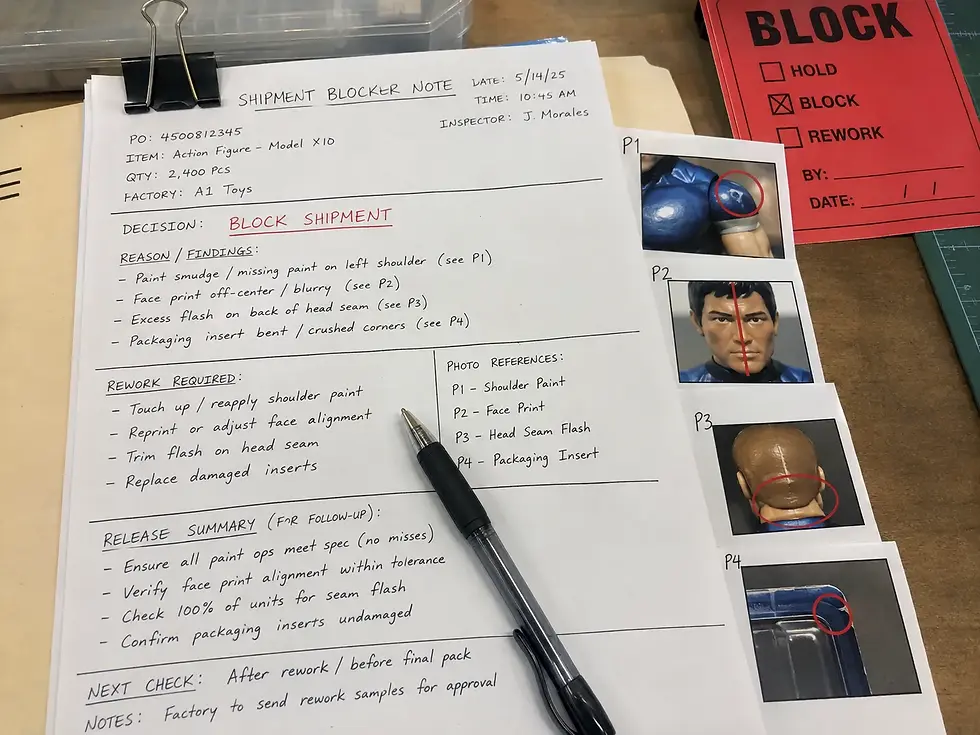
Some findings should block shipment even if the sampled lot technically passes. A safety-critical defect is the obvious example. So is a document or identity mismatch serious enough to undermine the compliance file. If the barcode logic is wrong, the age grade is wrong, the warning set is wrong, the lot identity is unclear, or the goods no longer match the approved product version, the buyer may be looking at a shipment that is operationally unsafe to release even without a dramatic visual failure rate.
Other findings may justify rework rather than a full hold. Minor print scuffs on a small number of cartons, isolated cosmetic marks, or a limited labeling correction may be fixable if the root cause is clear and the lot can be rechecked cleanly. But rework should still be controlled. The buyer should know exactly which cartons or SKUs are affected, how the fix will be verified, and whether the issue points to a wider process failure.
The dangerous middle ground is the lazy compromise: it passed AQL, ship it anyway, and sort out the rest later. That approach is usually only a way of exporting risk from the factory to the buyer's warehouse, customer-service team, retailer account, or Amazon problem queue.
The release decision should therefore separate issues into three practical buckets.
The first bucket is ship. These are issues that remain inside the agreed tolerance, do not affect safety, function, identity, or documentation, and do not point to unstable process control.
The second bucket is rework and recheck. These are issues that can be corrected before dispatch without changing product identity, while leaving the lot clearly traceable and the correction easy to verify.
The third bucket is hold. These are issues where the buyer should keep the goods in place until the factory explains what happened and the corrected lot can be re-evaluated. Safety-critical findings, warning or barcode mismatches, wrong carton identity, lot-traceability weakness, missing release evidence, or construction drift belong here.
That is the real commercial use of inspection. Not a ceremonial PDF, but a disciplined path to ship, rework, or hold.
The evidence buyers should keep, not just the result
Many buyers ask for inspection photos, but not enough ask for the right ones.
The inspection file should support later decisions, not merely prove somebody visited the factory. If a lot is released, the buyer should be able to show what was checked and why release was considered acceptable. If a lot is blocked, the buyer should be able to show what failed, where it appeared, how it was tied to cartons or SKUs, and what corrective action was demanded.
The useful photo and evidence set usually includes product overview shots, close-ups of key defects, carton marks, barcode scans or label close-ups, packaging warning panels, assortment verification, lot or batch references, and shots that tie the physical goods back to the packing list and shipment identity.
That matters because weak evidence creates weak leverage. If the supplier later argues that the defect was isolated, or that the wrong carton photo came from another order, or that the lot code was never part of the release basis, the buyer needs a record that is harder to challenge.
It also matters because traceability is only partly a document problem. It is an evidence problem. The buyer should be able to tie the inspection findings back to batch, carton, SKU, and shipment identity clearly enough that later investigation does not become guesswork.
This is one of the reasons toy inspection has to go beyond workmanship and quantity. The buyer is not simply buying a pass result. The buyer is buying a defensible release decision.

How the release decision should actually be made
The cleanest release decision is not made from one number. It is made from a short chain of aligned answers.
Did the sampled defect picture fit the agreed AQL tolerance?
Did the toy still match the approved product version in function, build, labeling, and packaging?
Did any safety-critical or commercially serious finding appear that should override the sample pass?
Did the shipment identity, carton logic, and document trail still match what the buyer intends to import and sell?
Did the inspection record create enough evidence to defend the release decision later?
If the answer to those questions is clean, the buyer can release with much more confidence. If one of them breaks, the buyer should resist the temptation to treat the shipment as acceptable simply because the AQL math looked comfortable.
That is the sharper lesson behind toy inspection. AQL is useful, but it is not senior enough to make the shipment decision on its own.
This is also where buyer-side discipline separates strong importers from weak ones. A strong buyer does not ask the inspector only whether the lot passed. The strong buyer asks whether the goods, cartons, labels, and records still describe one controlled shipment that should actually be released.
That question is harder. It is also the one that saves money.
The real point of going beyond AQL
Buyers often think “beyond AQL” means adding more checkpoints for the sake of thoroughness. That is not the point. The point is to stop false passes from becoming real shipment problems.
The toy looks acceptable, but the wrong warning file was printed. The lot passes, but the barcode maps to the wrong SKU. The finish is mostly clean, but the batch identity is too weak to defend later. The cartons are packed, but the product version no longer matches the document route. Those are the failures that hurt commercial teams because they usually surface after the factory has already been paid or after goods have reached a channel that is expensive to correct.
So the buyer should use AQL for what it is good at and refuse to ask it to do the whole job.
Use it to structure defect sampling. Then make a separate release decision that looks at function, safety-critical detail, packaging, labels, shipment identity, paperwork match, and evidence quality. That is the practical inspection discipline toy shipments need.
Need help turning a toy inspection result into a release decision the factory can act on? Awen Hollek helps overseas brands, importers, and distributors tighten inspection criteria, match the lot back to packaging and compliance files, and decide when a shipment should ship, rework, split, or hold before avoidable problems leave China.
FAQ
Is AQL enough for toy pre-shipment inspection?
No. AQL is useful for sampled defect counting, but it does not answer the full release question. A toy lot can fit the agreed sampling tolerance and still have packaging, labeling, document-match, traceability, or safety-critical issues that should block shipment.
What toy defects should block shipment?
Anything that creates a real safety risk, a serious function failure, a warning or barcode identity problem, a document mismatch, or weak batch traceability should be treated as a possible shipment blocker. The exact threshold depends on the product, but the buyer should not let AQL math overrule a serious release risk.
What should be checked besides workmanship and quantity?
Function, safety-critical details, packaging version, warning labels, barcode and SKU logic, carton marks, lot identity, and whether the outgoing goods still match the approved sample and supporting compliance paperwork.
Should inspection photos be tied to batch, carton, and SKU?
Yes. Inspection photos are far more useful when they connect findings back to the shipment identity. That makes rework, supplier challenge, later traceability, and release-defense much easier.
How does the inspection connect to the shipment release decision?
Inspection should support a ship, rework, split, or hold decision. The buyer should use the AQL result as one input, then separately decide whether the full shipment is commercially and operationally safe to release.


Comments