
Toy Landed Cost in 2026: Why FOB Quotations Are No Longer Enough
A FOB quotation can make a toy project look simple.
The factory gives a unit price. The buyer compares two or three suppliers. One price is lower, so it feels like the better commercial option. In reality, that FOB number is only one line in the cost stack. It does not tell you what the toy will cost when it reaches the warehouse, sits in Amazon FBA, goes through a retailer's margin structure, or lands in a country with a different tariff route.
This is why toy landed cost matters. For overseas toy brands importing from China, the real question is not "Which supplier gave the lowest FOB price?" The better question is: "Which supplier, package, carton plan, compliance route, freight assumption, and sales channel gives us a product that still works after every real cost is included?"
That is a less comfortable question, because it forces the buyer to connect sourcing, packaging, logistics, compliance, retail pricing, and cash flow before the purchase order is placed. It also connects directly to the discipline of preparing a toy quotation request for Chinese factories: the buyer needs the right cost, packaging, compliance, and shipment inputs before comparing suppliers. But this is also where many toy projects are saved. A cheap FOB quote can become expensive very quickly when the carton is bulky, the duty assumption is wrong, the product needs another test round, the FBA size tier is weak, or the retailer's required master-carton configuration increases freight cost per unit.

What FOB Actually Tells You
FOB is useful, but it is not a business model. Under the ICC Incoterms rules, FOB defines a division of cost, responsibility, and risk around a named port or shipment point. It helps clarify what the supplier is responsible for and what the buyer takes over. It does not calculate the final cost of having sellable toy inventory in the destination market.
A toy FOB quote may include the factory's unit price, export carton, local movement to the agreed port, and export-side handling according to the agreed terms. It usually does not include destination duty, customs broker fees, import VAT or GST, inland transport, warehouse receiving, Amazon prep, storage, retailer chargebacks, compliance testing, inspection reserves, or the cost of fixing a weak packaging decision after the sample has already been approved.
That distinction matters because toys are not generic commodities. The same plastic part, plush character, activity kit, or electronic toy can have different cost behavior depending on material, age grade, packaging, carton cube, battery configuration, destination country, and sales channel. A supplier can be honest about FOB and still leave the buyer with a number that is not enough to make a buying decision.
The common mistake is treating FOB as the cost of the product. It is not. It is the visible factory-side number before the importer has paid for the rest of the journey.
Why Landed Cost Changes By Country
The same toy can have different landed costs in the United States, the European Union, the United Kingdom, Canada, Australia, or another destination. The factory price may be identical. The carton may be identical. The real imported cost can still change because tariff classification, duty, VAT or GST treatment, customs process, importer obligations, and compliance expectations are different.
In the United States, the buyer needs to think about HTS classification, normal duty, possible China-origin additional tariff exposure, merchandise processing fees or harbor maintenance fees where applicable, and toy safety obligations such as CPSC toy safety rules and Children's Product Certificate requirements. For China-origin goods, Section 301 tariff exposure can change the commercial picture sharply, and those assumptions should be dated and checked rather than guessed from memory.
In the European Union, the route is different. The buyer needs to check Access2Markets tariff and import requirements, duty, import VAT treatment, importer responsibility, EU toy safety expectations, EN 71 testing route, chemical restrictions, labels, and market-surveillance risk. A toy that looks fine on an FOB spreadsheet can become less attractive if the compliance pathway is not understood early.
In the United Kingdom, the buyer has to use the UK Trade Tariff route, consider VAT, customs declaration process, and UK toy safety expectations where relevant. Other markets have their own versions of the same problem. The important operating point is simple: there is no universal toy landed cost. There is a landed cost for a specific toy, under a specific classification, from a specific origin, into a specific destination, through a specific shipment and sales channel.

Retailer Wholesale And Amazon FBA Are Not The Same Game
A landed-cost model also has to match the sales channel. A toy brand selling to retailers is not solving the same equation as a brand selling through Amazon FBA or direct-to-consumer.
For the retailer or distributor channel, the buyer usually needs enough space between landed cost, wholesale price, distributor margin, retailer margin, promotions, returns, testing, packaging, and chargebacks. This is where toy margin math from FOB to retail becomes practical rather than theoretical. A rough toy-industry sanity check is that the FOB price often needs to sit far below the retail price, sometimes around one quarter or less of RRP depending on category, margin structure, retailer terms, freight, and risk. That rule of thumb is not a formula, but it explains why a product can look interesting at sample stage and then fail once the retail margin stack is applied.
Amazon FBA works differently. The unit economics are shaped by retail pack dimensions, shipping weight, FBA size tier, referral fee, storage cost, returns, prep requirements, barcode and labelling workflow, and whether the package survives ecommerce handling. A toy can be viable for wholesale but weak for FBA because the retail box is too bulky. Another toy can work on Amazon only if the packaging is redesigned early enough to reduce dimensional cost without damaging presentation or safety. The buyer should check the current FBA revenue and fee calculator rather than reusing old size-tier assumptions.
DTC through the brand's own warehouse has another profile again. The buyer may have more control over retail price and storytelling, but warehouse receiving, pick and pack, outbound parcel cost, customer returns, and damaged packaging still belong in the model.
This is where toy landed cost becomes practical rather than academic. The buyer is not only asking "What does this toy cost to import?" The buyer is asking "Does this toy still make sense in the channel where we plan to sell it?"
Smaller Packaging Can Matter More Than A Small FOB Saving
Packaging is one of the fastest ways to destroy a good-looking toy margin. It is also one of the areas buyers often approve too late.
For Amazon-style selling, retail pack size affects dimensional weight, storage, fee tiers, and customer delivery economics. An oversized box may look more premium in a showroom, but if it pushes the product into a worse size tier or takes too much warehouse space, the commercial result can be poor. A few millimeters can matter when a product is near a threshold.
For retail, the same packaging decision has different pressure. The pack must communicate value on shelf, protect the toy, meet labelling requirements, and fit retailer planograms or carton handling expectations. A retailer may also require a certain inner pack, master-carton quantity, barcode placement, carton mark, or pallet configuration. Those requirements can change cost even when the toy itself does not change.
This is why packaging should not be approved only as a visual design. It should be tested as a commercial object: retail-ready, shipment-ready, warehouse-ready, compliance-ready, and channel-ready. A pretty box that increases CBM, reduces units per carton, or increases damage risk is not just a packaging issue. It is a landed-cost issue.
Master Cartons Are A Hidden Cost Lever
Toy buyers often focus on the retail box and forget the master carton. Factories usually pack by fixed units per master carton. That decision affects CBM, gross weight, palletization, container loading, warehouse receiving, handling, and per-unit freight allocation.
A small change in retail-box dimensions can change how many units fit in one master carton. That can change freight cost per unit. It can also create awkward order quantities. If a retailer wants 12 units per master carton but the best carton efficiency comes from 10 or 16, somebody has to decide whether the retailer requirement, the carton strength, the warehouse handling, or the freight cost matters more.
Master-carton logic also affects inspection. If inner packs, assortment ratios, barcode positions, carton marks, and shipping labels are not defined, the buyer may approve a product but still have problems when goods reach a retailer, FBA warehouse, or 3PL. This is especially painful for toys with multiple colors, assorted characters, seasonal displays, or retail programs that require exact carton quantities.

The Toy-Specific Landed-Cost Stack
A useful landed-cost model for toys should start with FOB, but it should not stop there. It should include the cost lines that change the buying decision.
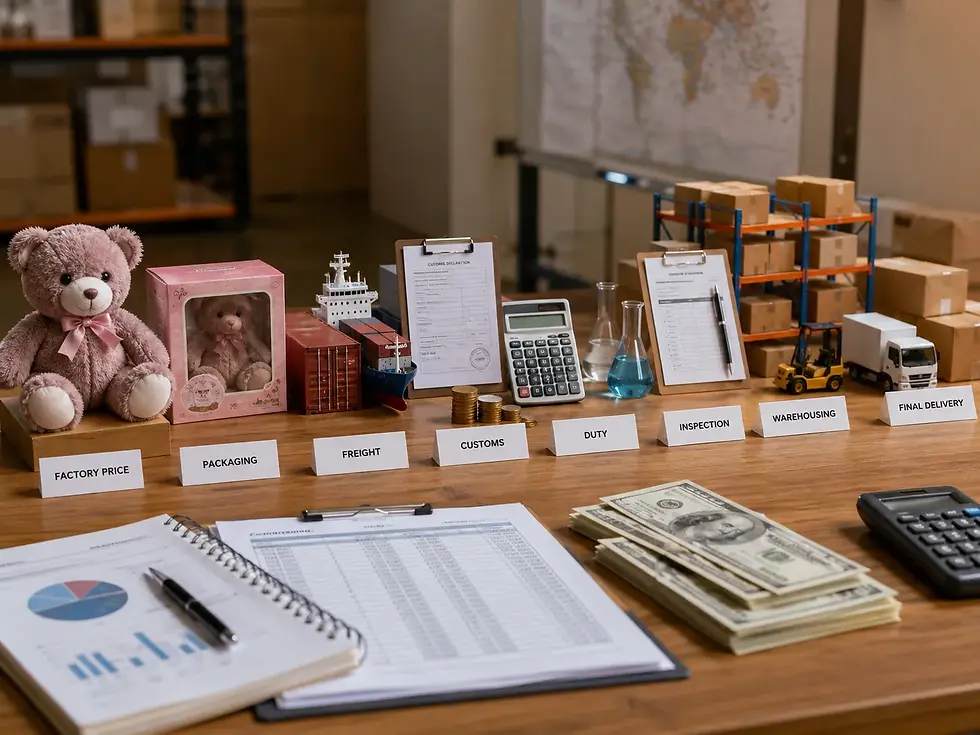
The stack normally includes factory unit price, tooling amortization where relevant, retail packaging, master carton, inspection, rework reserve, compliance testing, certificates, freight, insurance, customs value, duty, additional China-origin tariffs where applicable, port and terminal charges, broker fees, destination inland transport, warehouse receiving, storage, FBA prep or retailer prep, marketplace fees, retailer chargebacks, and a contingency for delay or rework.
The exact formula depends on the project. FCL and LCL do not allocate freight the same way. Air freight changes the whole cost logic. Courier shipments used for urgent replenishment can make a product look commercially impossible. Insurance, destination port, shipment timing, incoterm, tariff treatment, inland transport, and warehouse model can all change the result.
This is why landed-cost calculators are only useful when the assumptions are real. A spreadsheet that says "duty 5 percent" or "freight 0.20 per unit" without a current commodity code, destination route, carton CBM, shipment mode, and date is not a landed-cost model. It is a guess with columns.
How To Compare Suppliers Without Being Misled By FOB
Supplier comparison is where landed-cost discipline becomes useful. The goal is not to create a complicated spreadsheet for its own sake. The goal is to avoid choosing Supplier A because the FOB unit price is lower when Supplier B may be cheaper, safer, or more profitable after packaging, freight, compliance, and channel costs are included.
Imagine Supplier A is USD 0.08 cheaper FOB. On a 20,000-unit order, that looks like USD 1,600 saved. But Supplier A uses a bulkier retail box, packs fewer units per master carton, has less complete compliance documentation, and needs a higher inspection/rework reserve. Supplier B is more expensive FOB but uses a tighter pack, better carton efficiency, cleaner documentation, and fewer assumptions around testing. The cheaper quote may not be cheaper at all.
A practical comparison should look at FOB unit price, retail pack dimensions, master-carton quantity, carton CBM, gross weight, testing readiness, defect risk, incoterm assumptions, lead time, shipment mode, destination duty, and channel costs. If the product is headed to Amazon, include FBA fee and storage logic. If it is headed to retail, include wholesale margin, retailer requirements, carton rules, and chargeback risk.
Be Careful With DDP, CIF, FOB, And EXW Shortcuts
Incoterms are important, but they are not magic. They move responsibilities and costs between buyer and seller. They do not remove the need to understand the cost stack.
EXW can look cheap because much of the work sits with the buyer. FOB is clearer for many export projects, but it still leaves the destination side open. CIF may include freight and insurance to a destination port, but the buyer still needs to understand what happens after arrival. DDP can be convenient, especially for small buyers, but it can also hide customs assumptions, tariff treatment, importer-of-record questions, and weak documentation.
For toys, the risk is not only price. It is also compliance traceability, which is why reducing toy compliance risk before development should be part of the cost conversation before the buyer commits to tooling, packaging, or a purchase order. If a logistics shortcut makes it unclear who is responsible for import documentation, product classification, safety paperwork, or market access, the buyer should slow down. Convenience is useful only when the underlying assumptions are clean.
A Pre-Order Landed-Cost Checklist
Before choosing the supplier or approving production, the buyer should confirm the target country, commodity code, tariff and VAT assumptions, sales channel, retail pack dimensions, master-carton dimensions, units per carton, shipment mode, testing route, inspection reserve, warehouse or FBA requirements, and final supplier comparison.
That checklist should be dated. Tariff and fee assumptions can change. Freight markets change, as shown in UNCTAD's Review of Maritime Transport. Amazon fee logic changes. Retailer requirements change. A landed-cost model should show when the assumptions were checked and what source was used.
The buyer should also separate confirmed costs from estimates. A confirmed testing quote is not the same as an internal allowance. A supplier's suggested HS code is not the same as a verified import classification. A freight estimate without carton dimensions is not a reliable per-unit freight cost. A DDP quote without documentation clarity is not enough to understand risk.
The Real Lesson
A FOB quotation is useful at the start of a sourcing decision. It is not enough to approve a toy.
In 2026, the buyer needs to understand the product by destination country, packaging format, master-carton plan, sales channel, shipment method, and compliance route. That is the difference between comparing factory prices and comparing commercial outcomes.
Need help turning a factory quote into a real toy landed-cost decision? Awen Hollek helps overseas toy brands, inventors, and distributors pressure-test supplier quotes, tariff assumptions, compliance costs, packaging dimensions, master-carton plans, and China-side production decisions before a small FOB saving becomes an expensive commercial mistake.
FAQ
What is landed cost for toys?
Landed cost for toys is the estimated total cost of getting a toy from the factory quote to sellable inventory in the destination market. It can include FOB price, packaging, freight, insurance, duty, tariffs, customs broker fees, testing, inspection, warehouse receiving, storage, FBA prep, retailer requirements, and local delivery.
Why is FOB not enough when importing toys from China?
FOB does not include many destination-side and channel-specific costs. A toy can have a low FOB price but become expensive after freight, tariffs, compliance testing, packaging cube, master-carton configuration, warehouse handling, or marketplace fees are included.
Why can toy import costs be different in the USA, EU, and UK?
Each market has its own tariff lookup route, duty and tax treatment, compliance expectations, importer obligations, and documentation process. The same China-origin toy can have different landed-cost results depending on destination country, classification, material, function, and sales channel.
How do Amazon FBA packaging and fees affect toy landed cost?
Amazon FBA economics are sensitive to retail pack dimensions, weight, storage, referral fees, prep requirements, and returns. A package that looks acceptable for retail may be too bulky for marketplace profitability, so FBA packaging should be considered before the product and carton plan are approved.
Why do master-carton dimensions matter when importing toys?
Master-carton dimensions affect CBM, units per carton, container loading, warehouse handling, per-unit freight allocation, inspection, and retailer or FBA receiving. A small retail-box change can reduce carton efficiency and raise the real cost per unit.
Is DDP safer than FOB for toy imports?
Not automatically. DDP can be convenient, but it may hide customs assumptions, importer responsibility, tariff treatment, and documentation quality. For toys, the buyer still needs clarity on compliance, product classification, safety documents, and who carries import risk.


Comments